

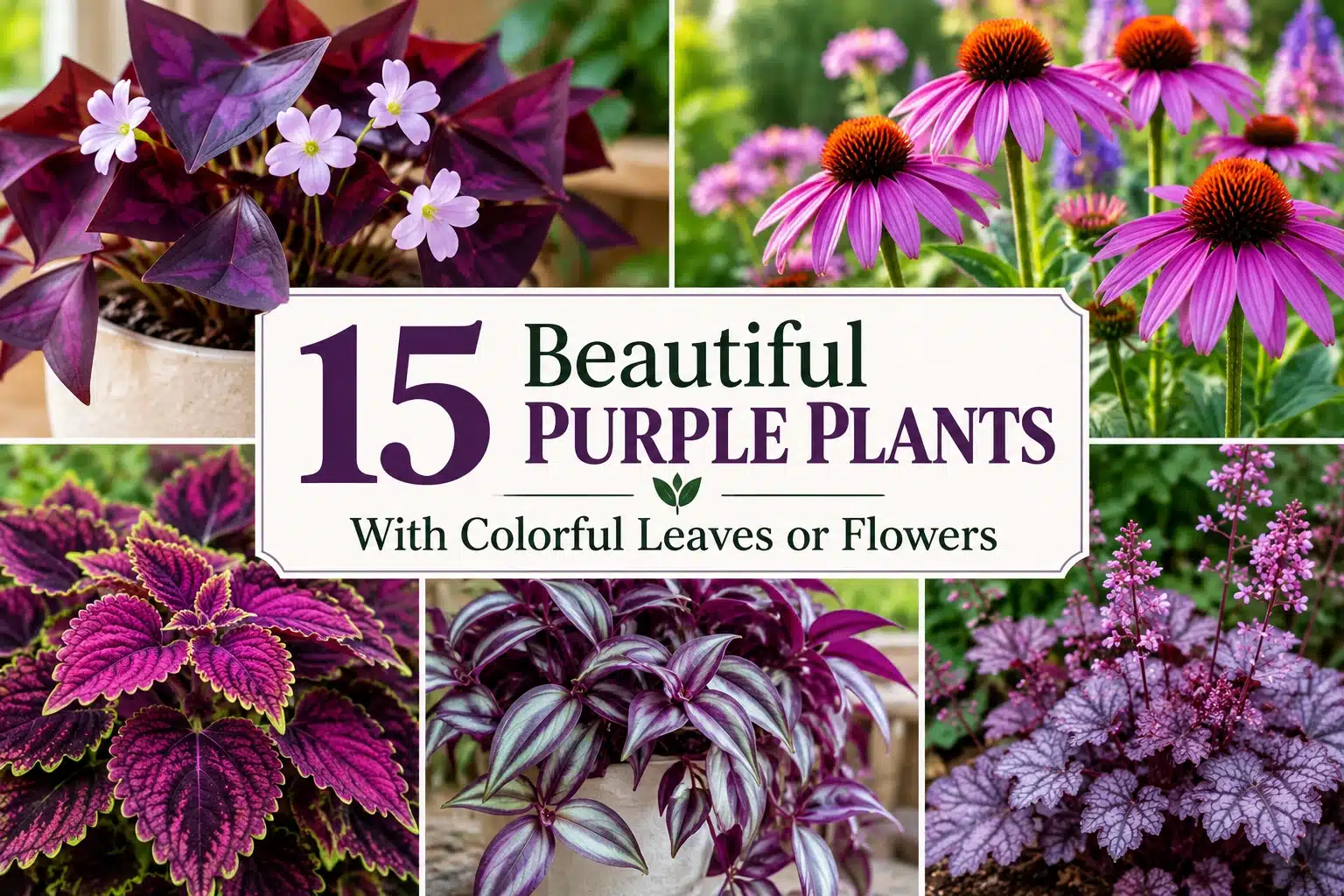
Purple plants can brighten a windowsill, container, or garden bed, but the best choice depends on whether you want colorful leaves or purple flowers. For indoor foliage, consider purple passion plant or purple shamrock; African violets offer blooms. Outdoors, coral bells provide purple-toned leaves, while lavender and coneflowers add seasonal flowers.
The distinction matters: foliage plants can keep their color through much of the growing season, while flowering plants bring color when they bloom. Sunlight, moisture, and winter hardiness also vary widely—lavender needs full sun and excellent drainage, but purple passion plant prefers bright, indirect light. Compare 15 varieties below to find one that suits your space and climate.
In This Article
Purple Plants at a Glance: Which Should You Choose?
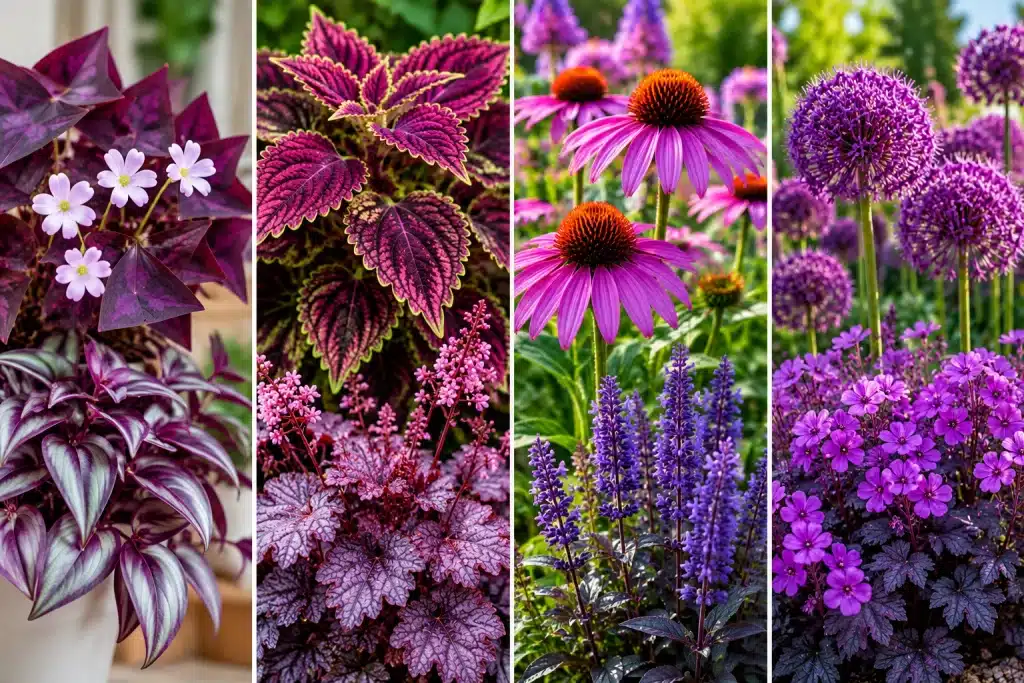
The comparison below will help you find a plant that matches your space, lighting, and growing conditions.
Plant name | Purple feature | Best location | Light | Growth habit | Important consideration |
Leaves | Both | Full sun to partial shade outdoors; very bright light indoors | Trailing, spreading | Strongest purple color in full sun; frost-sensitive | |
Leaves | Both | Sun to partial shade | Compact, clumping | May enter dormancy; needs winter protection in colder regions | |
Leaves | Indoor | Bright, indirect light | Sprawling, trailing | Purple coloration can fade in insufficient light | |
Leaves | Both | Bright, filtered light | Upright, bushy | Tropical plant; frost damages foliage | |
Leaves | Both | Shade to full sun outdoors (varies by cultivar); bright light indoors | Upright, mounding | Choose a purple cultivar; frost-sensitive | |
Leaves | Outdoor | Sun to partial shade; afternoon shade in hot climates | Compact, mounding | Foliage may shift from purple to bronze-green in summer heat | |
Leaves | Outdoor | Full sun to partial shade | Trailing, spreading | Vigorous growth; frost-sensitive | |
Leaves | Outdoor | Full sun to partial shade | Large, arching shrub | Deciduous; requires substantial growing space | |
Flowers | Indoor | Bright, filtered light | Compact, rosette-forming | Choose a purple-flowering cultivar; flowering depends on suitable growing conditions | |
Flowers | Outdoor | Full sun | Compact, mounding shrub | Requires excellent drainage; struggles in persistently wet soil | |
Flowers | Outdoor | Full sun to partial shade | Upright, clumping | Typically produces pinkish-purple summer-to-fall blooms | |
Flowers | Outdoor | Full sun to partial shade | Upright, clumping | Seasonal flower spikes; cutting back spent blooms may encourage reblooming | |
Flowers | Outdoor | Full sun to partial shade | Tall, upright | Prefers average to moist soil; tall stems may require support | |
Flowers | Outdoor | Full sun; some afternoon shade in hotter southern areas | Mounding, spreading | Lavender-blue flowers; high humidity can be challenging | |
Flowers | Outdoor | Full sun to partial shade | Upright, clumping | Needs good drainage and may self-seed |
A useful starting point: For a bright indoor room without strong direct sunlight, consider purple passion plant or African violet. For sunny outdoor containers, purple heart and ornamental sweet potato vine offer trailing foliage. If you’re filling a perennial garden bed, coneflowers, woodland sage, and blazing star are worth considering, provided the soil and climate suit them.
Keep in mind that “outdoor” doesn’t always mean winter-hardy. Some tropical purple plants can grow outside during warm weather but need protection when temperatures drop. Before choosing a permanent outdoor planting, check your local conditions using the USDA Plant Hardiness Zone Map.
Finally, check the exact variety before buying. Coleus and African violets come in several colors, and even plants marketed as purple may display burgundy, violet, lavender, or pinkish-purple shades rather than deep purple.
8 Purple Plants With Colorful Foliage
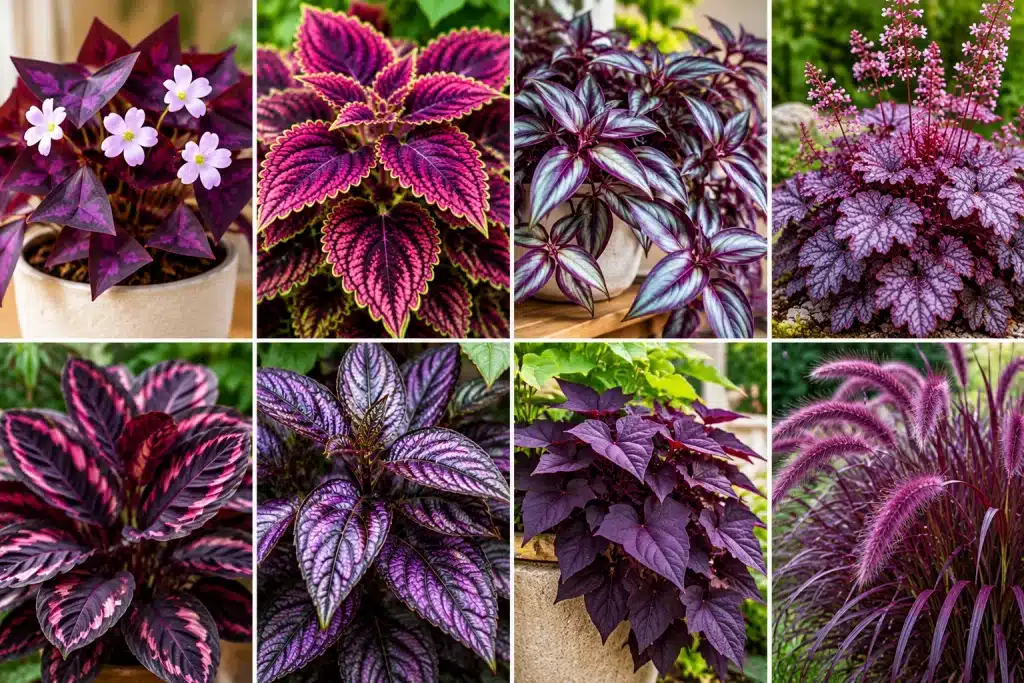
Purple foliage plants bring color to a space even when they aren’t flowering. Some spill over the edges of hanging baskets, others form neat mounds in garden beds, and a few grow into full-sized landscape shrubs.
The best choice depends on where you want to grow it. Tropical varieties may need to spend winter indoors, while cold-hardy perennials can return year after year. These eight purple plants offer different leaf shapes, growth habits, and care requirements. For plants with two-tone foliage, see our guide to plants with purple and green leaves.
Purple Heart — Tradescantia pallida
Purple Heart has long, pointed leaves and fleshy stems in rich violet-purple shades. Its trailing growth makes it especially attractive in hanging baskets, patio containers, and garden borders, where the stems can spill naturally over the edges. Small pinkish-purple flowers occasionally appear, but the foliage is the main attraction. In outdoor beds, its stems can spread beyond the intended planting area, so monitor and trim unwanted growth, as noted by NC State Extension.
For the strongest purple color, grow it in full sun outdoors. Plants kept in shade often develop greener leaves. Indoors, choose a bright window that provides plenty of light. Purple Heart prefers well-drained soil with adequate moisture during active growth, although established plants tolerate some drought. Reduce watering during winter when growth slows.
According to North Carolina State University Extension’s Purple Heart guide, the plant is hardy in USDA Zones 10–11. In colder regions, grow it as a seasonal outdoor plant or bring containers inside before cold weather.
Selection tip: Choose Purple Heart if you want trailing foliage rather than a compact, upright plant. Pinching back long stems encourages bushier growth. Its sap can also irritate skin, so handle cut stems carefully.
Purple Shamrock — Oxalis triangularis
With its triangular, butterfly-like leaflets, Purple Shamrock looks quite different from most traditional houseplants. Purple-leaved selections range from burgundy to deep maroon, often with lighter markings toward the center. The leaves fold at night and reopen during the day, while delicate white or pale pink flowers add occasional contrast.
Purple Shamrock works well in tabletop pots, decorative planters, and partially shaded garden beds. Provide bright light indoors or sun to partial shade outdoors. Use a well-draining potting mix, and allow the soil surface to dry between waterings rather than keeping the container continuously wet.
One unusual characteristic is its ability to enter dormancy. The foliage may die back during autumn or after periods of excessive heat or dryness. This doesn’t necessarily mean the plant is dead. As explained by NC State Extension’s Purple Shamrock profile, watering should be reduced during dormancy until new growth appears.
Outdoors, it is generally suitable for USDA Zones 8–11. Gardeners in colder regions should grow it indoors or provide appropriate winter protection.
Selection tip: Choose Purple Shamrock if you enjoy unusual leaf shapes and have room for a small potted plant. Be prepared for occasional dormancy, and keep it away from pets that might chew its leaves because Oxalis contains potentially harmful soluble oxalates.
Purple Passion Plant — Gynura aurantiaca
Purple Passion Plant gets its distinctive appearance from fine purple hairs covering its green leaves and stems. These hairs create a soft, velvety surface that can look especially vibrant when light catches the foliage. Its weak, spreading stems make it a natural fit for hanging baskets or containers placed on shelves.
This tropical plant prefers bright, indirect light, with protection from harsh afternoon sunshine. Too little light can make its leaves appear greener and reduce the purple effect. Keep the soil moderately moist during active growth, but use a container with drainage holes to prevent waterlogging and root rot. Water less frequently in winter.
NC State Extension’s Purple Passion Plant profile recommends pinching back stems to encourage bushier growth and reduce legginess. The species is hardy outdoors only in warm climates, generally USDA Zones 10–12, making indoor cultivation the practical choice for most U.S. households.
Small orange-yellow flowers may appear, but they have an unpleasant odor and are often removed.
Selection tip: Choose Purple Passion Plant for a bright indoor spot where its fuzzy foliage can be appreciated up close. It’s a better choice for someone who enjoys occasional pruning than someone seeking a strictly upright, low-maintenance plant.
Persian Shield — Strobilanthes auriculata var. dyeriana
Few purple foliage plants have the metallic appearance of Persian Shield. Its elongated leaves display violet, deep purple, green, and silvery tones, often with dark green veins and purple undersides. The foliage gives containers and garden beds a bold, tropical look.
Persian Shield grows into an upright, bushy plant, making it particularly useful as a focal point in a mixed container or a partially shaded garden border. It prefers rich, well-drained soil that remains consistently moist without becoming waterlogged.
Lighting requirements vary with climate. NC State Extension’s Persian Shield profile recommends bright light without direct sun. The University of Wisconsin–Madison Extension also notes that plants can tolerate full sun in cooler northern areas but usually benefit from partial shade in southern states.
Persian Shield thrives in warm conditions and can lose some of its brilliant coloring when temperatures are cool, or light is insufficient. It is commonly grown as a seasonal annual in colder climates or kept indoors over winter. Its ability to survive outdoors year-round depends on winter temperatures and site conditions.
Selection tip: Choose Persian Shield when you have enough room for an upright accent plant and can provide regular watering. If you’re growing it outdoors in a cold-winter region, plan to bring it inside before frost or replace it the following season.
Purple Coleus — Coleus scutellarioides
Coleus offers an impressive range of leaf patterns, from burgundy and deep purple to combinations of pink, red, green, and nearly black. Its often scalloped or serrated leaves provide color without relying on flowers.
For a predominantly purple display, look for a named cultivar such as ‘Color Blaze Dark Star,’ which has deeply colored, serrated foliage. Other cultivars may combine purple with contrasting edges or veins.
Coleus is especially useful in outdoor containers, garden borders, and mixed seasonal plantings. It can also grow indoors with sufficient bright light.
Unlike plants with relatively consistent light requirements, coleus varies considerably by cultivar. Traditional varieties generally prefer some shade, while modern selections can tolerate full sun. The University of Minnesota Extension’s coleus guide explains these differences and recommends regular watering, particularly for container-grown plants.
Use fertile, well-drained soil and water when the upper soil begins to dry. Containers exposed to summer heat may need more frequent watering than plants growing in garden beds. Pinching the growing tips can create a fuller shape, while removing flower spikes helps keep attention on the foliage.
Coleus is cold-sensitive and is generally grown as an annual outside frost-free climates.
Selection tip: Don’t buy a plant labeled simply “purple coleus” without checking the specific cultivar. Its mature size, sunlight tolerance, and exact leaf colors can differ significantly from another purple selection.
Purple Coral Bells — Heuchera ‘Palace Purple’
‘Palace Purple’ Coral Bells forms a tidy mound of broad, lobed leaves that resemble small maple leaves. Depending on growing conditions and the season, the foliage may appear bronze-purple, olive-green, or deep purple, with rich wine-red undersides.
Unlike many tropical purple plants, this is a hardy perennial suited to garden beds and outdoor containers. Its compact habit makes it particularly useful along shaded pathways, at the front of borders, or among other woodland plants.
‘Palace Purple’ grows in sun to partial shade, but afternoon shade is beneficial in regions with hot summers. Plant it in organically rich, well-drained soil and maintain consistent moisture without leaving the roots saturated. When planting, keep the crown at or slightly above the soil surface.
According to NC State Extension’s ‘Palace Purple’ profile, this cultivar is hardy in USDA Zones 4–9. Its foliage may shift toward bronze-green during hot weather, so its color shouldn’t be expected to remain uniformly deep purple year-round.
Small, pale flowers rise above the leaves on slender stalks in late spring or early summer.
Selection tip: Choose ‘Palace Purple’ if you want a compact, cold-hardy foliage plant for a garden border. If maintaining a particular shade of dark purple is your priority, compare available Heuchera cultivars rather than assuming they all hold their color equally well.
Ornamental Sweet Potato Vine — Ipomoea batatas ‘Blackie’
‘Blackie’ is an ornamental sweet potato vine grown for its striking, deeply divided leaves in dark purple to nearly black shades. The leaves create a dramatic contrast with lime-green, silver, or brightly flowering companion plants.
Its vigorous, trailing stems make it particularly effective in large hanging baskets, patio planters, and mixed containers. It can also spread across garden beds as a seasonal groundcover.
Grow ‘Blackie’ in full sun to partial shade with fertile, well-drained soil. Water regularly while plants establish, especially in containers. Although established sweet potato vines tolerate occasional dry conditions, container-grown plants may require more frequent watering during hot weather. Avoid allowing the roots to remain in saturated soil.
NC State Extension’s ornamental sweet potato guide identifies ‘Blackie’ as a deep purple-black cultivar and notes that ornamental varieties are selected for attractive foliage rather than high-quality edible roots.
The plant is frost-sensitive and typically grown as a warm-season annual in most of the United States. Its stems can spread quickly, so occasional trimming may be necessary in smaller arrangements.
Selection tip: Choose ‘Blackie’ for a generously sized outdoor container where its trailing growth has room to develop. If you have limited space, be prepared to trim the vines so they don’t overwhelm neighboring plants.
Purple Ninebark — Physocarpus opulifolius ‘Diablo’
Purple Ninebark offers something the smaller plants on this list cannot: the structure of a full-sized landscape shrub. ‘Diablo’ produces dark purple to burgundy, lobed leaves along arching branches, with clusters of pale pinkish-white flowers in late spring or early summer.
This shrub works well in mixed borders, informal hedges, and larger landscape plantings. Unlike Purple Passion Plant or ornamental sweet potato vine, it is a woody perennial adapted to winters across much of the United States.
Ninebark grows in full sun to partial shade and tolerates a variety of soil conditions, provided drainage is adequate. Water regularly while establishing new plants. Once established, it can tolerate periods of drought, although prolonged dry conditions may still call for supplemental watering. According to NC State Extension, purple-leaved cultivars may lose some color intensity with prolonged sun exposure.
NC State Extension’s Ninebark profile describes the species as a large, adaptable shrub, typically growing several feet tall and wide. It also identifies ‘Diablo’ as a purple-leaved selection.
Ninebark is deciduous, meaning it loses its leaves in fall. Its peeling bark provides additional visual interest in winter, but it will not maintain a purple leafy display through the cold season.
Selection tip: Choose ‘Diablo’ if you have enough landscape space for a substantial shrub rather than a small container plant. Check its expected mature dimensions before planting, and if pruning is needed, do it after flowering to avoid removing the following year’s flower buds.
7 Purple Flowering Plants for Indoors and Gardens
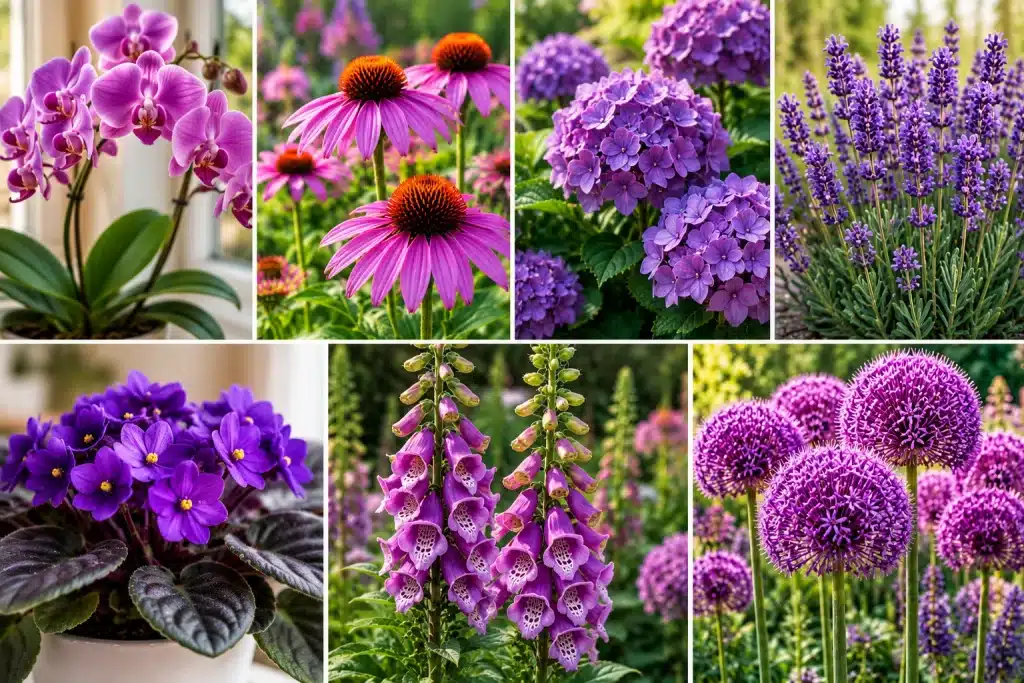
Purple flowering plants offer everything from delicate indoor blooms to tall flower spikes that attract pollinators. African violets are a practical choice for indoor color, while lavender, coneflowers, and woodland sage suit sunny garden beds. For taller, more naturalistic plantings, blazing star and anise hyssop bring height and seasonal interest.
Not every plant sold as purple produces the same shade. Flowers may be violet, lavender-blue, pinkish-purple, or deep purple, depending on the species and cultivar. Blooming periods also vary, so check the exact variety and its growing requirements before buying.
African Violet — Streptocarpus ionanthus
African violets are compact houseplants with softly textured leaves and clusters of delicate flowers held above the foliage. Although their name suggests one color, their blooms range from white and pink to lavender, violet, and deep purple. For a reliably purple display, choose a specific cultivar such as ‘Persian Prince,’ which produces dark purple flowers.
These plants are especially suited to windowsills, shelves, and small indoor spaces. They prefer bright, filtered light rather than intense direct sunlight. A bright window with gentle morning light can work well, while an LED grow light can supplement natural light in darker rooms.
Use a well-draining African violet potting mix and keep it lightly moist, never soggy. When watering, direct room-temperature water onto the soil or water from below, allowing excess moisture to drain. Avoid leaving water on the leaves, which can cause spotting.
With suitable light, moisture, and temperatures, African violets can flower several times throughout the year rather than following one brief outdoor blooming season. The University of Minnesota Extension’s African violet care guide explains that insufficient light can prevent flowering, while excessive light may damage the foliage.
African violets are tropical plants generally grown indoors across the United States. NC State Extension’s botanical profile also confirms that Streptocarpus ionanthus was formerly classified as Saintpaulia ionantha.
Selection tip: If you want a compact purple-flowering houseplant, African violet is a strong choice. Check the cultivar label carefully, since plants with nearly identical foliage can produce very different flower colors.
English Lavender — Lavandula angustifolia
English lavender is known for its fragrant, narrow gray-green leaves and slender spikes of lavender-purple flowers. The blooms rise above a compact, mounded shrub, making it attractive along sunny pathways, in herb gardens, and near seating areas where its fragrance can be appreciated.
Flowering generally occurs in summer, although timing depends on the cultivar and local climate. Purple and lavender shades are common, but some cultivars produce pink or white flowers.
Give English lavender a location with at least six hours of direct sunlight and exceptionally good drainage. It performs best in soil that dries reasonably well between waterings. Once established, it tolerates relatively dry conditions, but newly planted lavender still needs regular watering while developing roots.
The greatest challenge is often moisture rather than cold. Heavy clay, persistently wet soil, and humid conditions with poor air circulation can contribute to root rot and other problems. In regions with wet soil, raised beds or appropriately prepared, well-drained planting sites may improve growing conditions.
According to NC State Extension’s English lavender profile, the species is generally suitable for USDA Hardiness Zones 5–9, although regional humidity and drainage can affect its long-term performance.
After flowering, remove spent flower spikes and prune as appropriate to maintain a compact shape. Avoid cutting heavily into old, leafless woody stems.
Selection tip: Choose English lavender if you have a sunny, well-drained outdoor location. If your garden stays wet after rainfall, improving drainage should take priority over increasing watering or fertilizer.
Purple Coneflower — Echinacea purpurea
Purple coneflower produces large, daisy-like flowers with pinkish-purple petals surrounding a raised, coppery-brown central cone. The petals often angle downward as the flower matures, giving it a distinctive appearance.
Native to parts of the central and eastern United States, this perennial is well suited to sunny flower borders, meadow-style plantings, and pollinator gardens. Its flowers attract bees and butterflies, while seed heads left standing can provide food for birds.
Purple coneflowers typically begin flowering in early summer and may continue into early fall under favorable conditions. They grow best in full sun but tolerate some partial shade. Average, well-drained garden soil is usually suitable, and established plants can withstand periods of drought.
The NC State Extension profile of Echinacea purpurea describes its adaptability, wildlife value, and characteristic pinkish-purple flowers. Plants commonly grow several feet tall, so leave enough space for their mature size.
Deadheading can keep plants tidy, but removing every faded flower also removes potential seed heads. If supporting birds and other wildlife is a priority, consider leaving some standing through fall and winter.
Selection tip: Choose the straight species if you want the familiar pinkish-purple flowers. Many modern coneflower cultivars have been bred in orange, yellow, red, white, and other colors, so the common name alone doesn’t guarantee purple blooms.
Woodland Sage — Salvia nemorosa
Woodland sage produces upright spikes packed with small violet-blue flowers above aromatic green foliage. Its dense floral stems create strong vertical accents, especially when several plants are grouped together along a border or pathway.
This clump-forming perennial works well in cottage gardens, pollinator beds, and sunny perennial borders. It generally flowers from early summer into late summer, with additional blooming possible when spent flower stems are removed.
Grow woodland sage in full sun for abundant flowering, although partial shade is tolerated. It prefers well-drained soil and can handle occasional dry conditions once established. Water new plants regularly until established, then adjust watering according to rainfall and soil moisture rather than keeping the ground constantly wet.
One of its useful characteristics is its ability to produce another flush of flowers after cutting back faded stems. The NC State Extension woodland sage guide recommends removing spent flowering stems down toward the basal foliage to encourage additional blooms.
Woodland sage is generally hardy in USDA Zones 4–8. Its flowering performance can vary with local temperatures, growing conditions, and the selected cultivar.
Selection tip: Look for a named cultivar if you want a particular shade or mature height. Woodland sage selections and related Salvia hybrids can differ in flower color, plant size, and blooming behavior.
Dense Blazing Star — Liatris spicata
Dense blazing star creates tall, upright spikes covered in small, closely packed flowers. Most commonly seen in shades of violet-purple, the flowers open from the top of each spike downward, an unusual characteristic that makes the plant easy to recognize.
The narrow, grass-like foliage forms a clump near the base, while flowering stems may rise several feet above surrounding plants. This makes blazing star especially useful toward the middle or back of a perennial border, in native plant gardens, or among ornamental grasses.
Dense blazing star typically blooms in midsummer, providing vertical color when many spring-flowering plants have finished. Its flowers also attract bees, butterflies, and other pollinators.
Plant it in full sun for strong flowering, although some partial shade is tolerated. Unlike lavender, which needs comparatively dry conditions and sharp drainage, dense blazing star performs well in average to moist, well-drained soil. It is native to moist meadows and other habitats in the eastern United States.
The NC State Extension guide to Liatris spicata notes its preference for moisture, summer flowering period, and distinctive top-down blooming pattern. It is generally hardy in USDA Zones 3–8.
Although it tolerates occasional wet conditions better than many drought-adapted perennials, that doesn’t mean its roots should remain continuously waterlogged.
Selection tip: Choose dense blazing star if you want tall purple flower spikes in a sunny bed with reasonably consistent moisture. For a particularly deep purple display, check the cultivar rather than assuming every blazing star selection has identical flower coloring.
Walker’s Low Catmint — Nepeta × faassenii ‘Walker’s Low’
Walker’s Low catmint forms soft, spreading mounds of gray-green, aromatic foliage topped with masses of lavender-blue flowers. Its relaxed growth habit makes it useful along garden edges, around pathways, and beside roses or other upright flowering plants.
Despite its name, Walker’s Low isn’t necessarily a tiny plant. Under suitable conditions, it can reach about 2 feet tall and spread 18–36 inches wide, so it needs enough room to form its natural mound.
It prefers full sun and well-drained soil, including relatively dry or rocky ground. Once established, it tolerates drought better than plants requiring consistently moist soil. In hotter southern regions, however, some afternoon shade may be beneficial.
Flowering can begin in spring and continue through summer, with additional blooms possible into fall. Cutting back spent flower stems encourages fresh growth and can extend the colorful display.
According to NC State Extension’s Walker’s Low catmint profile, this cultivar is generally hardy in USDA Zones 4–8. High humidity can be challenging in some southern climates, particularly where air circulation is limited.
Its flowers attract pollinators, including bees and butterflies. However, the lavender-blue coloring is usually softer and bluer than the rich violet tones associated with some other purple flowering plants.
Selection tip: Choose Walker’s Low if you want a long-flowering, informal border plant with a soft lavender-blue appearance. Give it room to spread, and avoid expecting the compact size its name might suggest.
Anise Hyssop — Agastache foeniculum
Anise hyssop produces upright spikes of small blue-purple flowers above fragrant green leaves. When the foliage is crushed, it releases a distinctive scent often compared to anise or licorice.
Native to parts of North America, this herbaceous perennial is particularly well suited to pollinator gardens, meadow-style plantings, and mixed perennial borders. Its flowers attract bees and butterflies, while its upright stems add height without the dense, woody structure of a shrub.
Anise hyssop generally flowers from summer into fall, although the exact blooming period depends on the region and growing conditions.
Grow it in full sun to partial shade, preferably in well-drained soil. Established plants can tolerate some dryness, but young plants benefit from regular watering while their roots develop. Avoid sites where water collects around the crown, especially during winter.
The NC State Extension anise hyssop profile describes its pollinator value, fragrant foliage, and adaptability to mesic-to-dry growing conditions. The species is generally hardy in USDA Zones 4–8, provided its soil and winter conditions are suitable.
Anise hyssop can self-seed, which may be useful in naturalistic gardens but less desirable in highly controlled planting designs. Remove spent flower spikes before seeds mature if you want to limit unwanted seedlings.
Selection tip: Choose anise hyssop if your priority is supporting pollinators while adding blue-purple flower spikes to a sunny garden. If exact flower color matters, inspect the plant or cultivar photographs before purchasing; some selections appear noticeably bluer than others.
How to Choose and Care for Purple Plants
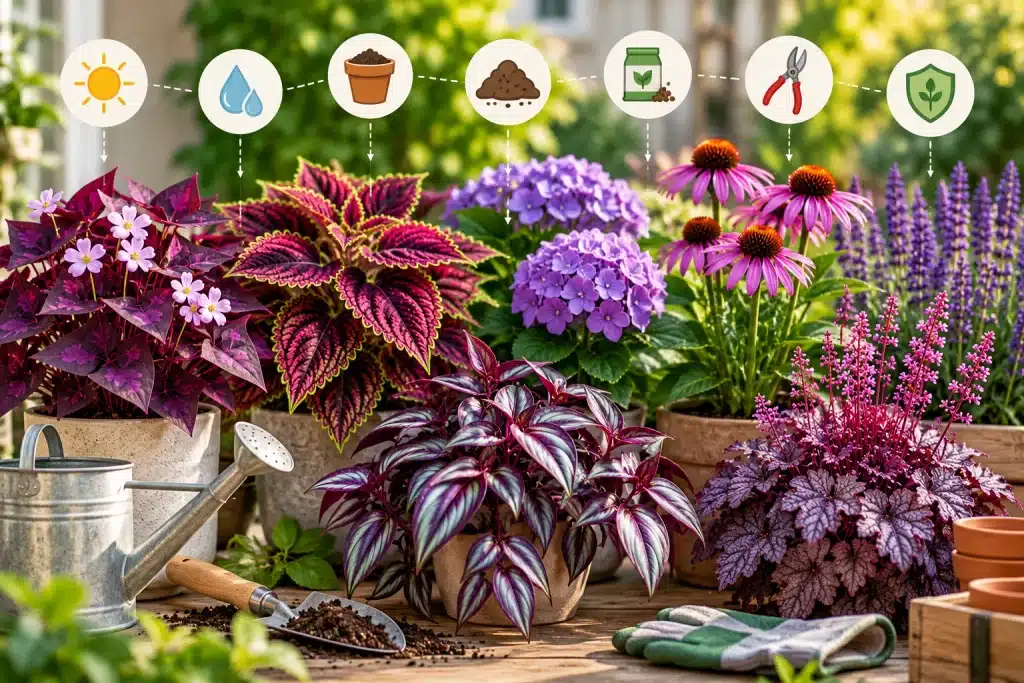
Choosing the right purple plants involves more than finding a shade you like. The amount of sunlight your space receives, your local climate, and how often you can water or maintain your plants all affect which varieties will grow successfully.
Before buying, check the requirements of the specific species or cultivar. A purple-leaved houseplant and a purple-flowering garden perennial may have very different needs, even if they look equally vibrant at the nursery.
Match the Plant to Your Light Conditions
Some purple plants develop their richest colors in direct sunlight, while others perform better with filtered light. Choosing the wrong exposure can lead to faded foliage, weak growth, fewer flowers, or leaf damage.
For example, Purple Heart (Tradescantia pallida) develops stronger purple coloring in full sun. Plants growing in shade often become noticeably greener. NC State Extension’s Purple Heart guide confirms this relationship between sunlight and foliage color.
English lavender (Lavandula angustifolia) also needs full sun for healthy growth and flowering. By contrast, Purple Passion Plant (Gynura aurantiaca) prefers bright, indirect light with protection from harsh afternoon sun. African violets (Streptocarpus ionanthus) likewise flower best when they receive sufficient filtered light without excessive direct sunlight.
Here’s a practical comparison:
Light condition | What it means | Suitable purple plants |
Full sun | At least 6 hours of direct sunlight daily | Purple Heart, English Lavender |
Partial shade | Approximately 2–6 hours of direct sunlight, preferably avoiding intense afternoon exposure when appropriate | Purple Coral Bells, Persian Shield in suitable outdoor conditions |
Bright, indirect light | Plenty of daylight without prolonged, intense direct sun | Purple Passion Plant, African Violet |
These categories are starting points, not universal rules. Light tolerance can vary with climate, season, and cultivar. For example, NC State Extension’s ‘Palace Purple’ Coral Bells profile recommends partial shade in hot-summer areas to help prevent foliage color from fading.
Practical tip: Before purchasing a plant, observe the intended location throughout the day. A sunny south-facing window, a shaded porch, and an exposed garden bed provide very different growing conditions. Match the plant to the light the space actually receives rather than choosing a location based on appearance alone.
Check USDA Hardiness Zones and Winter Protection
If you’re planting outdoors, your USDA Plant Hardiness Zone is one of the first things to check.
The USDA Plant Hardiness Zone Map allows you to enter your ZIP code and identify your local zone. The map is based on average annual extreme minimum winter temperatures, helping gardeners estimate which perennial plants are likely to survive winter outdoors.
For example, Purple Coral Bells (Heuchera ‘Palace Purple’) is generally hardy in Zones 4–9, making it suitable for many cold-winter gardens. Purple Heart, however, is hardy primarily in Zones 10–11 and is commonly grown as an annual or houseplant in colder regions.
That distinction matters when choosing between permanent garden plantings and seasonal container displays.
If a purple plant isn’t hardy in your area, you may be able to grow it outdoors during warm weather and move it inside before damaging cold arrives. Purple Heart and Persian Shield are examples of tropical or frost-sensitive ornamentals that can be managed this way when suitable indoor conditions are available.
For plants that naturally enter dormancy, such as Purple Shamrock, winter care is different. NC State Extension’s Purple Shamrock guide explains that the foliage may die back temporarily before new growth returns. During dormancy, watering should be reduced.
Remember that USDA zones don’t account for every growing challenge. Summer heat, humidity, soil drainage, rainfall, and local microclimates also influence whether a plant will thrive.
Practical tip: Use your USDA zone to assess winter survival, then check the plant’s light, drainage, and heat tolerance before deciding where to grow it.
Adjust Watering and Maintenance to the Species
Purple plants don’t share one ideal watering schedule. Their moisture requirements depend on the species, growing medium, temperature, season, and whether they’re planted in containers or garden soil.
English lavender, for example, needs excellent drainage and performs poorly in persistently wet soil. Dense Blazing Star (Liatris spicata) prefers average to moist, well-drained conditions, making it more suitable for garden sites that retain some moisture.
Purple Passion Plant needs a different approach again. Its potting mix should remain moderately moist during active growth, with less frequent watering during winter.
These differences are documented in NC State Extension’s guides for English Lavender, Dense Blazing Star, and Purple Passion Plant.
Plant | Watering approach | Useful maintenance |
English Lavender | Let well-drained soil dry between waterings once established; avoid persistent moisture | Remove spent flower spikes and prune appropriately |
Dense Blazing Star | Maintain average to moderately moist, well-drained soil | Leave some standing stems for wildlife where appropriate; support tall stems if needed |
Purple Passion Plant | Keep moderately moist during active growth; reduce watering in winter | Pinch back stems to encourage fuller growth |
Purple Shamrock | Allow the soil surface to dry between waterings; reduce watering during dormancy | Allow the plant to rest until new leaves emerge |
Woodland Sage | Water regularly while establishing; tolerate drier conditions once established | Cut back spent flower stems to encourage additional blooming |
Watering shouldn’t follow a rigid calendar. Before adding water, check the soil’s moisture and consider whether the plant is actively growing or resting.
Maintenance also varies. Pinching back Purple Passion Plant helps control leggy growth, while deadheading Woodland Sage can encourage another flush of flowers. NC State Extension’s Woodland Sage profile recommends removing faded flowering stems toward the basal leaves.
By comparison, Purple Shamrock may naturally lose its foliage during dormancy. Increasing watering to force new growth during that period could create unnecessary problems.
Practical tip: When a plant looks unhealthy, examine its soil moisture, drainage, light exposure, and seasonal growth pattern before assuming it needs more water or fertilizer.
Check Pet Safety Before Bringing Plants Indoors
If you have cats or dogs, check the safety of each plant before placing it where they can reach it.
Purple foliage doesn’t indicate whether a plant is toxic or non-toxic. Even closely related ornamentals can have different safety information, so identification by common name alone isn’t always reliable.
The ASPCA’s Toxic and Non-Toxic Plant Database is a useful starting point. Search using the plant’s scientific name whenever possible, and confirm that the listing refers to the species you’re considering.
For example:
- Purple Shamrock (Oxalis triangularis): The ASPCA’s Oxalis listing identifies the genus as toxic to cats and dogs because it contains soluble calcium oxalates. The ASPCA lists salivation and tremors as possible signs and notes that kidney failure is rare in dogs and cats.
- Purple Heart (Tradescantia pallida): NC State Extension reports that ingestion may cause mouth and stomach irritation in pets, while contact with the plant’s sap or leaves can irritate the skin.
- African Violet (Streptocarpus ionanthus): The ASPCA lists African violets as non-toxic to cats and dogs under their former botanical classification, Saintpaulia.
A non-toxic classification doesn’t mean a plant is suitable for eating. Chewing plant material can still cause gastrointestinal upset, and an incorrect plant identification can lead to a misleading safety assessment.
If your pet tends to chew leaves or dig in containers, place plants somewhere genuinely inaccessible or choose verified non-toxic alternatives. If you suspect your pet has eaten a toxic plant, contact your veterinarian or the ASPCA Animal Poison Control Center promptly rather than waiting for symptoms.
Practical tip: Keep the plant’s nursery label or record its scientific name when purchasing it. Accurate identification makes it easier to check toxicity information and get appropriate veterinary guidance if an exposure occurs.
The best purple plants are the ones that suit your growing conditions, not simply those with the most striking colors. Before choosing, consider how much sunlight your space receives, how well the soil drains, and whether the plant can survive your local winters.
If you have pets, check the plant’s safety using its botanical name. With those basics covered, you can confidently choose a variety that brings the foliage, flowers, and growth habit you want—without taking on care requirements your space can’t support.


