

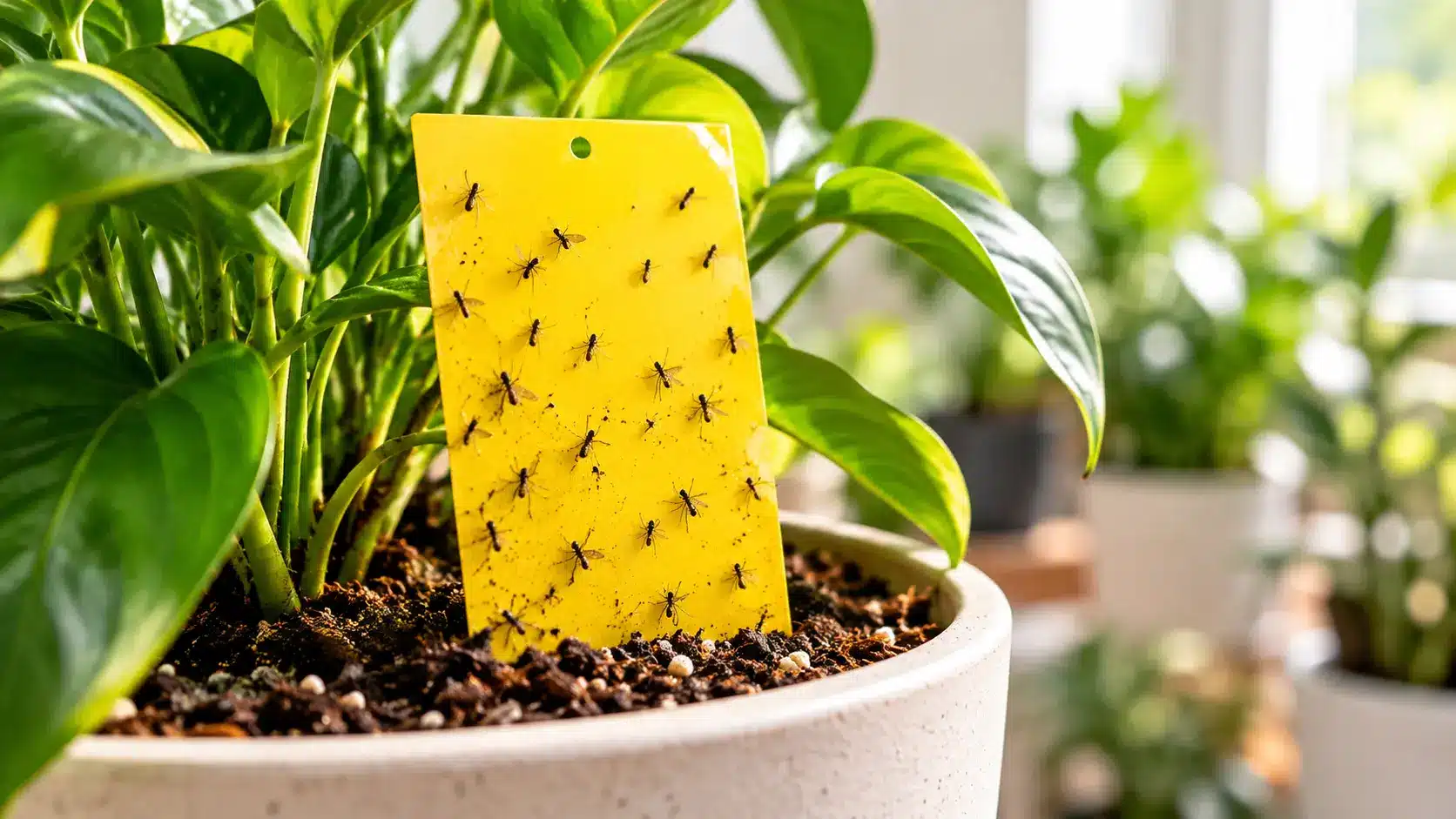
To learn how to get rid of fungus gnats, start by reducing excess moisture in your houseplant soil, catching flying adults with yellow sticky traps, and treating soil-dwelling larvae with Bti when necessary. The key is to interrupt their life cycle without letting your plants dry out more than they can tolerate.
Here’s what many plant owners overlook: catching the flying gnats doesn’t eliminate the eggs and larvae already hiding in the potting mix. That’s why these tiny pests can keep returning even after the adults seem to disappear.
This guide explains which treatments university pest-management research supports, which popular home remedies lack reliable evidence, and how to prevent another infestation while keeping your houseplants healthy.
In This Article
How to Get Rid of Fungus Gnats: Step-by-Step
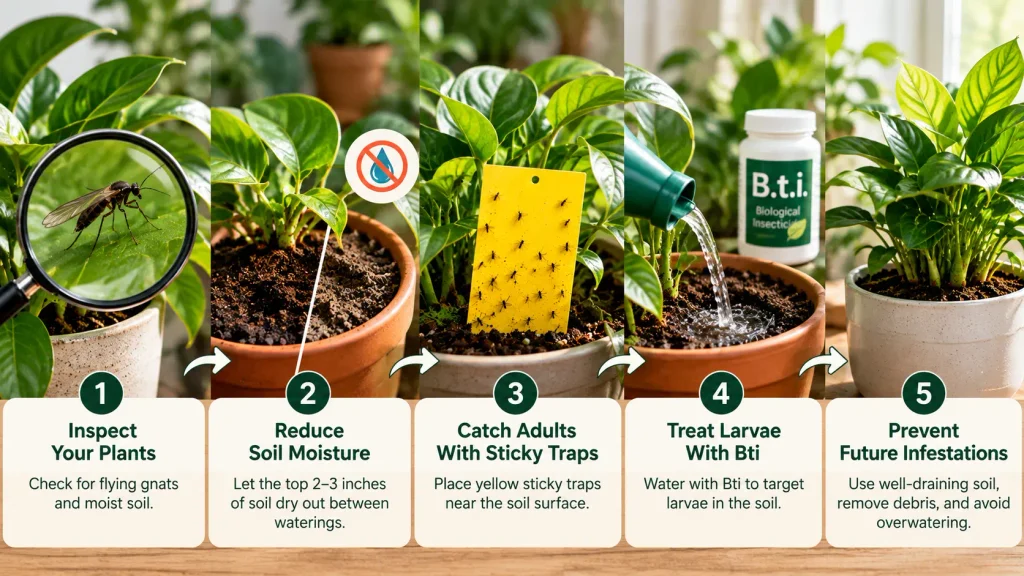
To get rid of fungus gnats in houseplants, focus on three things: reducing excess moisture in the potting soil, trapping adult gnats, and controlling the larvae living beneath the surface. Treating only the flying insects won’t solve the problem because new adults can continue emerging from infested soil.
The following five steps combine practical prevention with pest-control methods recommended by university Extension specialists.
Step 1 — Find Which Plants Are Infested
Start by checking the houseplants where you’ve noticed tiny flies. Fungus gnats are often seen walking across damp potting soil, hovering around plant containers, or resting near windows.
Inspect each pot carefully, especially plants that stay moist for long periods. Gently disturbing the soil surface may cause adult gnats to move or fly.
To locate the source of an infestation:
- Check nearby houseplants. Gnats may be breeding in more than one container, even if most of the flies seem concentrated around a single plant.
- Examine the potting mix. Look for consistently damp soil and decaying leaves or other organic debris.
- Use yellow sticky traps. Place a trap near the soil surface of each suspected plant to help identify where adults are active.
- Check for larvae with raw potato. Place a small piece of raw potato, cut side down, against the soil. After a few days, lift it and look for tiny, pale larvae with dark heads.
The potato method helps detect larvae that are otherwise difficult to see. Remove and discard the potato pieces after checking them.
The University of California’s Integrated Pest Management program recommends both yellow sticky traps and raw potato pieces for monitoring fungus gnat populations.
Finding the breeding containers first makes it easier to focus treatment where it is needed instead of treating every plant unnecessarily.
If you’re unsure which insects are affecting your houseplants, start by identifying common houseplant pests before choosing a treatment.
Step 2 — Let the Soil Surface Dry Appropriately
Fungus gnats thrive in moist growing media. Their larvae feed primarily on fungi and decaying organic matter, so constantly damp potting soil provides favorable breeding conditions.
Reducing unnecessary moisture is one of the most useful ways to make those conditions less favorable.
For houseplants that tolerate drying between waterings, allow the upper 1–2 inches of soil to dry before watering again. Use your finger to check the moisture rather than relying strictly on a calendar.
Also make these adjustments:
- Empty saucers after watering. Don’t leave pots sitting in standing water.
- Check drainage holes. Make sure excess water can escape from the container.
- Remove decaying debris. Clear fallen leaves and other decomposing material from the soil surface.
- Reconsider watering frequency. A plant in a cool room or low-light location may use water more slowly than the same plant in brighter, warmer conditions.
However, not every houseplant should dry out to the same depth.
Snake plants and many succulents generally tolerate longer drying periods. Moisture-loving plants, such as some ferns and prayer plants, may suffer if their potting mix becomes excessively dry.
For those plants, focus on eliminating soggy conditions and improving drainage while maintaining the moisture their roots need.
Colorado State University Extension and UC IPM’s fungus gnat management guidance identify moisture management as a central component of fungus gnat control.
The goal is not to dehydrate your houseplants. It’s to prevent potting soil from staying unnecessarily wet.
Step 3 — Catch Adult Gnats With Yellow Sticky Traps
Yellow sticky traps are a simple way to capture flying adult fungus gnats while you address the breeding conditions in their pots.
Choose traps designed for indoor plants. Small adhesive cards mounted on stakes are convenient because they can sit close to the soil surface.
For better results, place them just above the potting mix, where fungus gnats frequently walk and fly. Use additional traps around other affected containers if needed.
Check the traps regularly. If a card becomes covered with insects, dust, or debris, replace it.
Remember that sticky traps only capture adults. They do not kill eggs, larvae, or pupae already inside the potting mix.
That’s why traps work best alongside moisture management and, when needed, larval treatment.
According to the University of Minnesota Extension’s indoor plant pest guide, yellow sticky cards are useful for detecting adult fungus gnats but should not be the only control method.
You can also use them to monitor progress. Check traps at similar intervals and compare the numbers caught. A sustained decline suggests adult activity is decreasing, although trap counts alone cannot confirm that every larva has been eliminated.
Step 4 — Treat Fungus Gnat Larvae With Bti
If fungus gnats continue appearing despite better watering practices and adult trapping, you may need to treat the larvae in the soil.
One evidence-based option is Bti (Bacillus thuringiensis subspecies israelensis), a naturally occurring bacterium used in certain biological insect-control products.
Bti works against susceptible fly larvae, including fungus gnat larvae. It does not kill flying adult gnats.
To use it appropriately:
- Choose a suitable product. Look for a Bti formulation whose label permits treatment of fungus gnats in the intended potting media or houseplant setting.
- Read the complete label. Confirm the permitted application method, dilution or dosage, and any restrictions.
- Apply it to the growing medium as directed. Depending on the formulation, this may involve a soil drench or another labeled application method.
- Repeat only as directed. More than one application may be necessary because Bti does not remain active indefinitely in indoor potting media.
- Continue monitoring adult activity. Existing pupae may still develop into adults after a larval treatment.
Not all products containing Bacillus thuringiensis are interchangeable. Different subspecies target different insects, so a product intended for caterpillars should not be assumed effective against fungus gnat larvae.
UC IPM’s biological control recommendations identify Bti as an option for controlling fungus gnat larvae and explain why repeated applications may be necessary.
For product safety, follow the U.S. Environmental Protection Agency’s guidance on pesticide labels. The approved label determines how and where a pesticide can be used.
Avoid increasing the concentration or applying treatments more frequently than the label allows. Using more product does not automatically produce better control.
Step 5 — Monitor and Prevent Another Generation
Even after you’ve started treatment, you may continue seeing fungus gnats for a while.
That doesn’t necessarily mean your efforts have failed.
Fungus gnats develop through four stages: egg, larva, pupa, and adult. Because several generations can overlap, adult flies may emerge from individuals already developing in the soil when treatment began.
Colorado State University Extension’s fungus gnat guide explains that development depends on environmental conditions, including temperature. The insect’s life cycle makes continued monitoring an important part of control.
Over the following weeks, keep checking three things:
- Adult activity: Are fewer gnats appearing on your sticky traps?
- Soil moisture: Are affected pots draining properly and drying to a level appropriate for each plant?
- Larval activity: If necessary, are raw potato checks showing fewer larvae?
Look for a consistent downward trend rather than expecting every fly to disappear immediately.
If adult numbers remain high, inspect nearby plants for overlooked breeding sites. Also check whether the soil is staying too wet or whether a larval treatment needs another application according to its label.
For persistent infestations, reassess the condition of the potting mix. Soil that remains waterlogged or contains excessive decomposing material may require replacement, but repotting is not necessary for every affected houseplant.
The most reliable approach is to keep reducing favorable breeding conditions while using traps and appropriate larval controls until activity remains low.
How to Tell Fungus Gnats From Other Small Flies
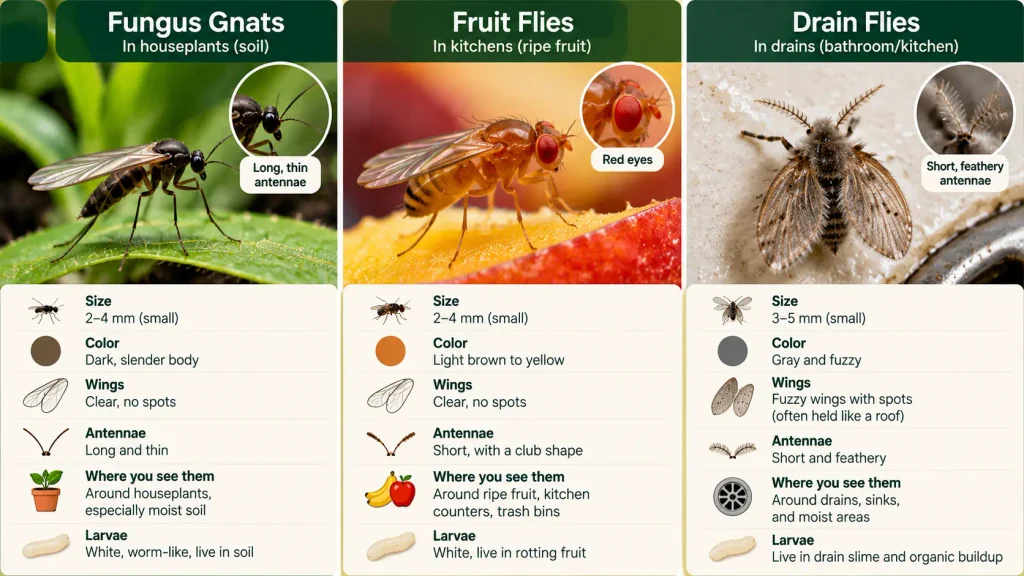
Fungus gnats are tiny, dark, mosquito-like flies with slender bodies, long legs, and thin antennae. Adults typically measure about 1/8 inch long and are often seen walking across potting soil or making short, erratic flights around houseplants.
Unlike stronger flying insects, fungus gnats tend to stay close to their breeding sites. You may notice them hovering just above the soil, moving when a plant is disturbed, or gathering near a window.
According to Colorado State University Extension’s fungus gnat identification guide, adult fungus gnats have delicate, dark bodies and a distinctive Y-shaped vein pattern on their wings. Their larvae look entirely different: tiny, translucent, worm-like creatures with shiny black heads that live within moist growing media.
Because these insects are so small, a phone camera with a close-up setting or a magnifying glass can make their distinguishing features easier to see.
Fungus gnats are commonly confused with fruit flies and drain flies, but a few physical differences can help narrow down the identification.
Feature | Fungus gnats | Fruit flies | Drain flies |
|---|---|---|---|
Appearance | Dark, slender, mosquito-like | Compact, often tan or brown | Fuzzy, moth-like |
Legs and antennae | Relatively long and thin | Generally shorter and less conspicuous | Shorter-looking, with hairy bodies and wings |
Typical activity | Weak, short flights near damp soil | Flying around ripening fruit or fermenting materials | Resting or making short flights near drains |
Common breeding habitat | Moist potting media | Fermenting fruit and organic food waste | Organic buildup inside drains and other wet areas |
Helpful identifying clue | Long legs, slender body, and dark-headed larvae in soil | Compact body; some common species have red eyes | Broad, hairy wings giving a miniature moth appearance |
These distinctions are consistent with guidance from UC Integrated Pest Management and the University of Maryland Extension’s drain fly identification guide.
Where you find a fly is a useful clue, but not definitive proof of its identity. Fungus gnats can occur around drains, while other small flies may also appear near houseplants. Look at the insect’s body shape and wing characteristics, and check for larvae in the suspected breeding material before choosing a treatment.
If the flies are slender and dark, repeatedly gather around moist potting soil, and you find translucent, black-headed larvae in that soil, fungus gnats are a strong possibility.
Correct identification matters because treating houseplant soil will not eliminate flies breeding in fermenting kitchen waste or drain buildup.
Why Fungus Gnats Keep Coming Back
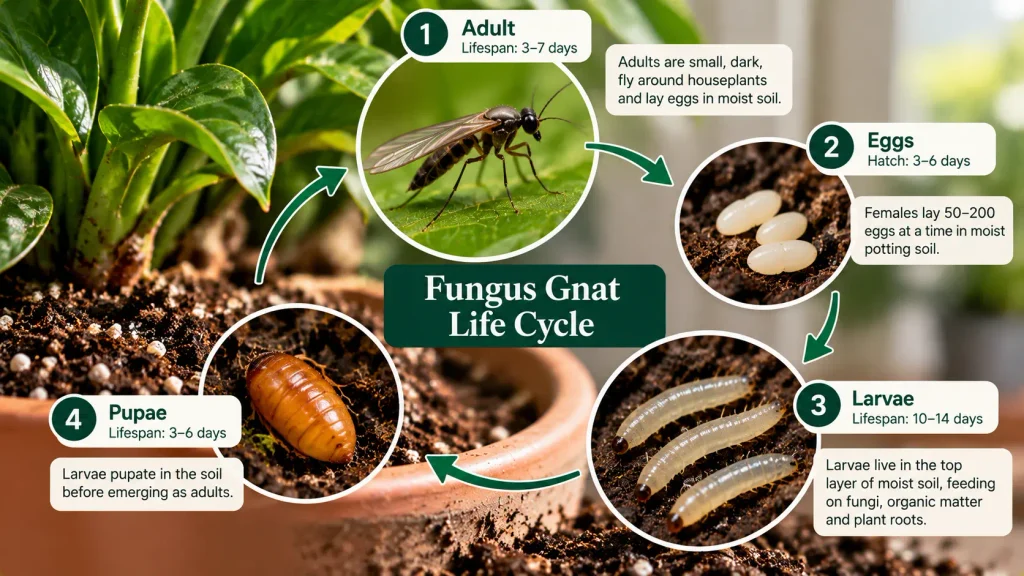
Fungus gnats keep coming back because their eggs, larvae, and pupae can remain hidden in potting soil long after you’ve trapped the flying adults. If the soil stays consistently damp, new gnats can emerge and reproduce, making the infestation seem endless.
One of the biggest reasons is persistently wet potting mix. Adult females are attracted to moist growing media, where they lay their eggs. The larvae develop beneath the surface, feeding mainly on fungi, algae, and decaying organic matter. Even if you catch dozens of adults, the next generation may already be developing in the pot.
Poor drainage can make the problem worse. Containers without adequate drainage, frequent watering, and potting mixes that hold excessive moisture create favorable conditions for fungus gnats. As growing media ages and breaks down, it may retain more water than it did when fresh. This is especially troublesome during cooler months, when many houseplants grow more slowly and use less water.
Colorado State University Extension’s guide to fungus gnats identifies moisture retention, aging growing media, and seasonal changes in plant water use as important factors behind recurring infestations.
Another reason is overlapping generations. Fungus gnats develop through four stages—egg, larva, pupa, and adult. At typical indoor temperatures of 65–75°F, development from egg to adult can take approximately three to four weeks. Because different life stages may be present simultaneously, removing adults today won’t necessarily stop more from appearing tomorrow.
Newly purchased houseplants, contaminated potting media, or plants brought indoors after spending time outside can also introduce fungus gnats. A plant may look perfectly healthy while immature insects are developing in its soil.
According to the University of California’s Integrated Pest Management program, most of a fungus gnat’s life is spent in immature stages within growing media or organic matter. This is why successful control depends on addressing breeding conditions and immature insects rather than focusing exclusively on flying adults.
How the fungus gnat life cycle keeps an infestation going
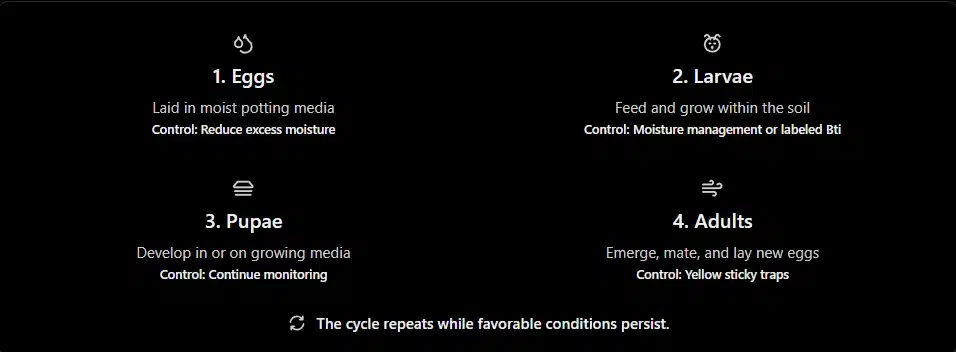
Conceptual life-cycle diagram based on UC IPM and Colorado State University Extension guidance. Treatments shown target different stages or breeding conditions; sticky traps and Bti do not directly control every stage.
If fungus gnats return after treatment, check whether the potting mix is still staying too wet, whether nearby plants were overlooked, or whether new adults are emerging from insects already present in the soil.
A few newly emerging flies do not automatically mean treatment has failed. However, continued heavy activity suggests that a breeding source remains. Addressing that source is what helps break the cycle instead of repeatedly catching adults.
Which Fungus Gnat Treatments Actually Work?
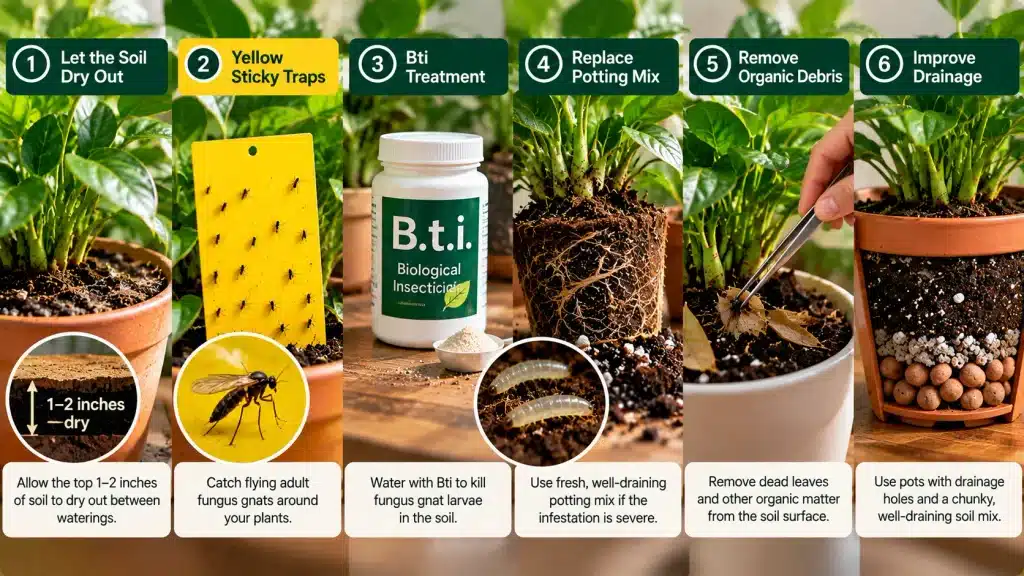
The most reliable fungus gnat treatments address the insects at different stages of their life cycle. Reducing excess soil moisture, using yellow sticky traps, and treating larvae with Bti or beneficial nematodes are supported by university pest-management guidance.
No single method is ideal for every infestation. Sticky traps reduce the number of flying adults but leave immature insects in the soil. Biological treatments target larvae, while better watering and drainage make potting media less favorable for breeding.
The University of California Integrated Pest Management program recommends combining moisture management with monitoring and, when needed, biological controls rather than relying primarily on insecticides aimed at adults.
Here’s how the common treatment options compare:
Treatment | Main target | Evidence-based role |
|---|---|---|
Moisture management | Breeding conditions and survival of immature gnats | Foundational control; helps make potting media less suitable for reproduction |
Yellow sticky traps | Flying adults | Captures adults and monitors activity; does not directly eliminate larvae |
Bti (Bacillus thuringiensis israelensis) | Larvae | Biological treatment that may require repeated, label-directed applications |
Steinernema feltiae | Larvae | Beneficial nematodes that work under suitable moisture and temperature conditions |
Fresh potting mix | Infested or poorly draining growing media | An option for persistent infestations, especially when existing media has deteriorated |
Hydrogen peroxide remedies | Proposed larval treatment | Limited evidence for a standardized, broadly safe houseplant treatment; effectiveness should not be guaranteed |
Cinnamon or vinegar home remedies | Unclear or variable | Insufficient reliable evidence to recommend as standalone fungus gnat controls |
The established approaches in this comparison are supported by Colorado State University Extension’s fungus gnat guidance, UC IPM, and the University of Minnesota Extension’s indoor pest management guide.
You may also encounter advice to drench infested soil with diluted hydrogen peroxide, sprinkle cinnamon over the surface, or set out bowls of apple cider vinegar.
These remedies should not be treated as interchangeable with Bti or beneficial nematodes. Hydrogen peroxide concentrations, contact times, and plant tolerance vary, and reliable evidence does not establish one universally safe and effective household recipe. Cinnamon is not an established fungus gnat larvicide, while vinegar traps are more commonly associated with attracting fruit flies than controlling fungus gnats in potting soil.
For most houseplant owners, the practical choice is to start with moisture management and monitoring, then add a targeted larval treatment if the infestation persists. This avoids unnecessary treatments while addressing the insects responsible for future generations.
When to Consider Beneficial Nematodes
Beneficial nematodes offer another biological approach when fungus gnat larvae continue developing in the soil.
Steinernema feltiae is a species of microscopic, insect-parasitic roundworm that searches for susceptible insect hosts within moist growing media. When properly applied under suitable conditions, these nematodes can infect and kill fungus gnat larvae.
This option may be especially useful for plants that cannot tolerate prolonged drying. For example, some ferns and other moisture-loving houseplants need consistently moist—but not waterlogged—soil to remain healthy.
Nematodes need adequate moisture to move through the growing medium and reach their targets.
According to UC IPM’s biological control guidance, Steinernema feltiae is effective against fungus gnats under moist conditions and at temperatures between approximately 60°F and 90°F. The publication also notes that these nematodes can reproduce and provide continuing control when conditions support their survival.
Because nematodes are living organisms, careful handling matters:
- Purchase the correct species. Look for Steinernema feltiae, rather than assuming every beneficial nematode product controls fungus gnats equally well.
- Check freshness and storage requirements. Products are perishable and may lose viability through improper storage or exposure to unsuitable temperatures.
- Follow the supplier’s directions. Mixing, application rates, and storage requirements depend on the formulation.
- Maintain suitable moisture. The growing medium should support nematode movement without becoming excessively wet.
- Avoid incompatible treatments. Check product guidance before combining nematodes with other pest-control materials.
Beneficial nematodes are not an instant solution for flying adults. They work within the growing medium, so improvements are generally assessed through declining adult emergence and continued monitoring.
For a small infestation in a drought-tolerant houseplant, correcting watering habits may be sufficient. Nematodes become more attractive when multiple pots are affected, the infestation persists, or drying the soil aggressively could harm the plants.
When Repotting Is Worth Considering
Repotting can help with persistent fungus gnat infestations, particularly when the existing potting mix has become compacted, poorly draining, or excessively moisture-retentive.
Over time, some organic growing media break down and lose their original structure. A mix that once drained freely may begin holding water for much longer, creating conditions favorable to fungus gnats.
Replacing that media can remove some immature insects and decaying material while giving the roots a better growing environment.
The University of Minnesota Extension’s guide to managing insects on indoor plants identifies repotting with fresh soil in a clean container as a management option for fungus gnats.
Consider repotting when the following conditions apply:
- Fungus gnats remain abundant despite appropriate watering adjustments and other controls.
- The growing medium stays wet for unusually long periods.
- The potting mix has noticeably decomposed or become compacted.
- Drainage problems cannot be corrected adequately with the existing setup.
If repotting is justified, choose fresh, appropriate potting mix and a clean container with drainage holes. Gently remove as much infested media as practical without tearing healthy roots, then repot at the correct depth and water according to the plant’s needs.
Avoid stripping or washing every root unnecessarily. Although removing old soil may reduce the amount of infested material transferred, aggressive root disturbance can stress houseplants, particularly sensitive species or plants already weakened by root problems.
Repotting also doesn’t guarantee that fungus gnats will disappear. Adults from nearby infested plants can recolonize the fresh growing medium if favorable breeding conditions remain.
For that reason, replacing the soil is best viewed as a targeted measure for troublesome containers, not a routine first step for every plant with a few fungus gnats.
The best treatment is ultimately the one that controls the infestation without creating a new problem for the plant. Match the method to the insect’s life stage, the condition of the potting mix, and the houseplant’s actual moisture requirements.
How Long Does It Take to Get Rid of Fungus Gnats?
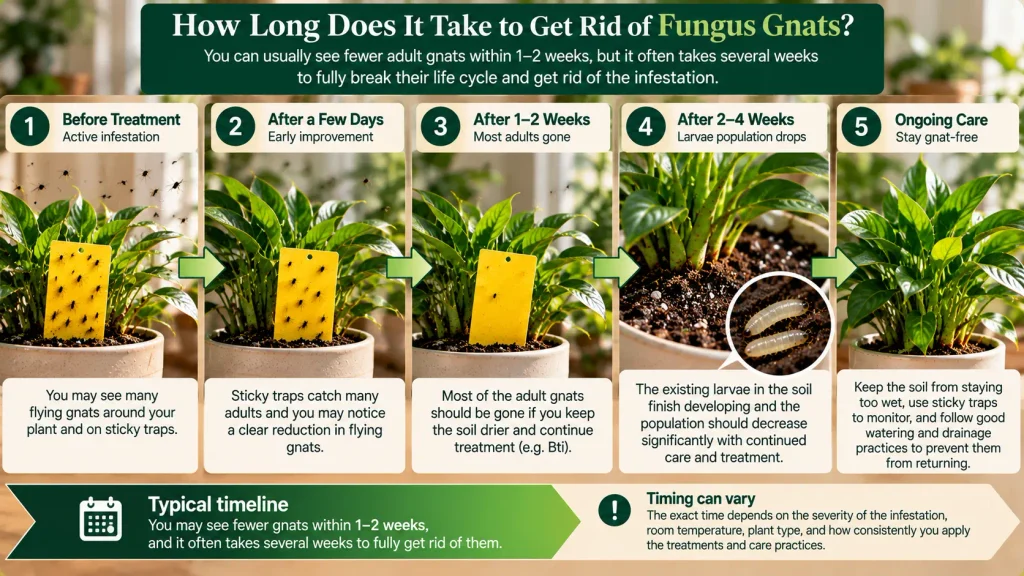
Getting rid of fungus gnats usually takes several weeks rather than a few days. You may notice fewer flying adults soon after placing yellow sticky traps and correcting overly wet soil, but immature gnats can remain hidden in the potting mix and emerge later.
At typical indoor temperatures of 65–75°F, fungus gnats can complete their development from egg to adult in approximately three to four weeks, according to Colorado State University Extension’s fungus gnat guide. This is a useful reference for understanding the infestation, not a guaranteed treatment timeline.
Development can be considerably faster in warmer conditions. The University of California Integrated Pest Management program reports that a generation can develop in about 17 days at 75°F, depending on conditions. Overlapping generations also mean eggs, larvae, pupae, and adults may be present at the same time.
When evaluating your progress, distinguish between three signs:
- Fewer adults on sticky traps: This is an encouraging sign that adult activity is declining. However, it doesn’t prove that eggs, larvae, or pupae have disappeared from the soil.
- Larvae remaining in the potting mix: New adults can still emerge after you begin trapping flies. Larval treatments such as Bti target susceptible larvae but don’t eliminate every life stage, so additional applications may be necessary according to the product label.
- Sustained control: Consistently fewer adults, reduced larval activity, and properly managed soil moisture provide stronger evidence that the infestation is being brought under control.
To track improvement, check sticky traps at regular intervals and compare catches over time. If you’re monitoring larvae with raw potato pieces, use the same method consistently so changes are easier to interpret.
Keep watering according to your plant’s needs rather than allowing the soil to become excessively dry just to eliminate the insects. If the number of gnats remains high after several weeks, check nearby pots for overlooked breeding sites and reassess whether the existing growing medium or treatment approach needs attention.
The goal isn’t to make every flying gnat disappear overnight. It’s to interrupt reproduction and keep breeding conditions unfavorable long enough for the infestation to decline without harming your houseplants.
How to Prevent Fungus Gnats From Returning
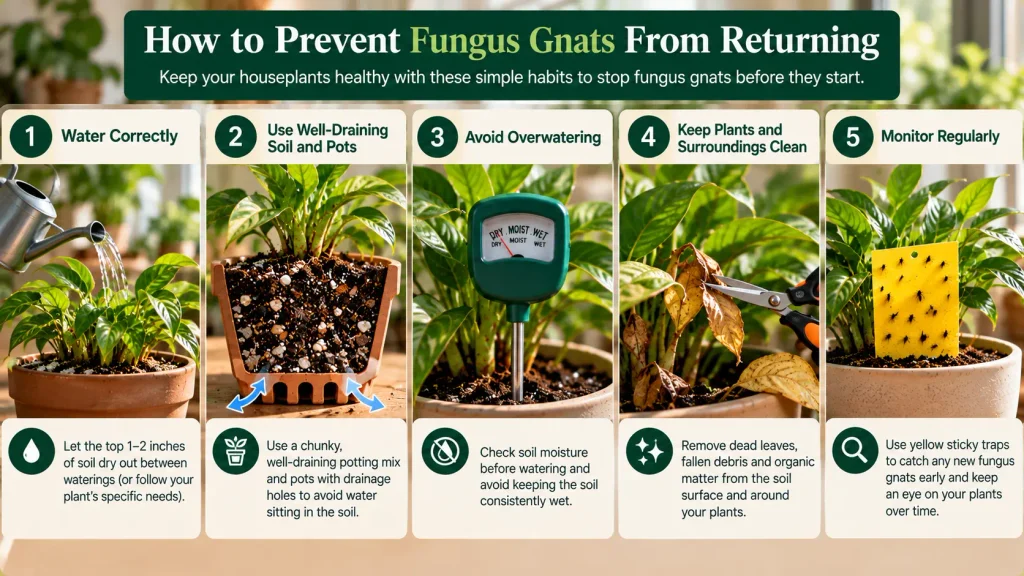
The best way to prevent fungus gnats from returning is to keep your houseplant soil from staying unnecessarily wet and reduce the places where the insects can reproduce. Once an infestation is under control, a few consistent plant-care habits can help keep it that way.
You don’t need to keep treating every plant with insecticides. Instead, focus on these preventive measures:
– Water according to the plant’s needs. Check the potting mix before watering rather than following a rigid weekly schedule. Allow the soil surface to dry between waterings as much as the plant can safely tolerate. Moisture-loving plants still need appropriate hydration, so avoid forcing every pot to dry out completely.
– Make sure containers drain properly. Use pots with adequate drainage holes and empty saucers or decorative outer pots when excess water collects. If a container remains wet for an unusually long time, check whether the growing medium has become compacted or holds too much moisture.
– Use fresh, appropriate potting mix. Choose a clean, commercially prepared mix suited to your plant. Avoid bringing garden soil indoors or using potting media that has been stored open and exposed to insects. Store unused potting mix in a closed container to reduce the chance of contamination.
– Remove decaying plant material. Clear fallen leaves, dead flowers, and decomposing stems from the soil surface. These materials can contribute to the moist organic conditions that support fungus gnat larvae.
– Inspect new plants before adding them to your collection. Look for small flies moving around the soil or emerging when the pot is disturbed. Check the growing medium for excessive moisture, and keep newly acquired plants separate from established houseplants for one to two weeks while watching for pest activity.
– Monitor your plants regularly. Pay attention to the soil surface when watering, especially around plants that prefer consistently moist conditions. Yellow sticky traps can help reveal early adult activity, but they aren’t necessary in every pot indefinitely.
These practices are supported by the University of California Integrated Pest Management program’s fungus gnat prevention guidance, which emphasizes drainage, reduced excess moisture, removal of organic debris, and clean growing media.
The University of Minnesota Extension’s indoor plant pest guide also recommends inspecting new plants, isolating them temporarily, maintaining clean containers, and checking regularly for insects before populations become established.
Prevention is especially important when expanding your houseplant collection. As Cornell Integrated Pest Management explains, fungus gnats can arrive with plants, containers, or soil and subsequently spread to other suitable growing media indoors.
If you notice a few adults again, inspect nearby pots and review their moisture conditions before the population increases. Early detection gives you a better chance of correcting the problem with simple care adjustments.
The goal isn’t to keep every pot completely dry or eliminate all organic matter from the soil. It’s to maintain healthy growing conditions for your plants while making those conditions less favorable for fungus gnats.
What to Do if Fungus Gnats Won’t Go Away
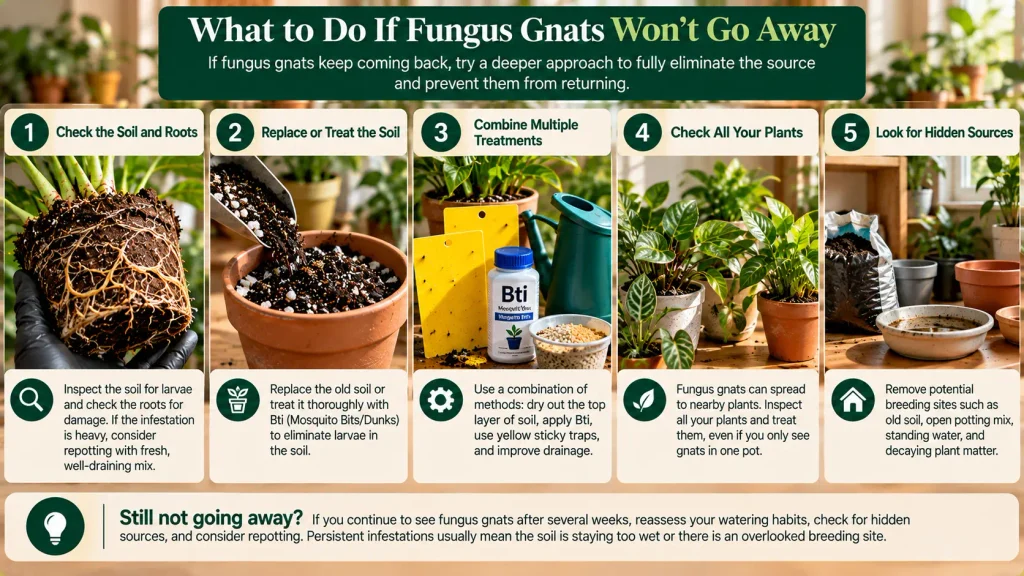
If fungus gnats keep appearing despite treatment, the problem is usually an overlooked breeding site, excess moisture, or larvae developing in the soil. Before trying another remedy, identify what’s allowing the infestation to continue.
Work through these troubleshooting steps:
1. Confirm that you’re dealing with fungus gnats. Examine the insects’ slender bodies, long legs, and mosquito-like appearance. If the flies seem concentrated around fruit, garbage, or drains instead of potting soil, check whether you’re dealing with a different pest. Finding translucent, black-headed larvae in the growing medium provides stronger evidence of fungus gnats.
2. Inspect every nearby plant. One untreated pot can continue producing adults even when you’ve successfully controlled the insects in another. Check plants that stay damp, including those in decorative containers where excess water may collect unnoticed.
3. Recheck soil moisture and drainage. If the potting mix remains soggy for days, watering adjustments may not be enough. Examine drainage holes, remove standing water, and determine whether the growing medium has become compacted or excessively moisture-retentive.
4. Check whether your larval treatment is appropriate. If you’re using Bti, confirm that the product contains Bacillus thuringiensis israelensis and is labeled for the intended application. Follow its directions for preparation, application, and repeat treatments. Bti targets susceptible larvae, not adults or pupae, so newly emerging flies don’t automatically indicate failure.
5. Consider replacing problematic potting mix. If a particular container remains heavily infested or the growing medium has deteriorated, repotting into fresh, suitable soil may help. Avoid unnecessary root disturbance, especially when the plant is already stressed.
These steps follow the principles outlined in the University of California Integrated Pest Management fungus gnat guide, which emphasizes identifying breeding sites, managing moisture, monitoring adults, and targeting immature insects.
The U.S. Environmental Protection Agency’s pesticide-label guidance also reinforces the importance of following the directions and restrictions on pesticide products rather than assuming that different formulations can be used interchangeably.
Use this quick troubleshooting guide to identify your next move:
What you’re noticing | Possible explanation | What to check next |
|---|---|---|
Sticky traps catch flies, but new adults keep appearing | Immature gnats remain in the growing medium | Check for larvae and consider an appropriate larval treatment |
Fungus gnats return after watering | The potting mix may remain excessively moist | Check drainage, watering frequency, and soil condition |
One plant improves, but flies remain in the room | Another container may be a breeding source | Inspect nearby pots and other damp organic material |
Traps catch few insects, but small flies remain around the kitchen or bathroom | The insects may not be fungus gnats | Recheck their appearance and possible breeding sites |
Bti treatment has begun, but adults still emerge | Pupae or other life stages may already be present | Continue monitoring and follow label-directed treatment intervals |
If your houseplant continues wilting despite a decline in fungus gnat activity, don’t assume the insects are responsible. Root rot, waterlogged soil, underwatering, and other root problems can cause similar symptoms.
The UC IPM guidance on fungus gnat damage explains that significant larval feeding can harm roots, particularly in seedlings and young plants, but other causes of unhealthy roots are more common explanations for wilting houseplants.
Check whether the growing medium is excessively wet or dry, whether drainage has failed, and whether the roots show signs of decay before deciding on further treatment.
Persistent fungus gnats don’t necessarily require stronger pesticides. Finding the untreated source and correcting the conditions that allow larvae to survive is usually more useful than repeatedly spraying the adults.
Getting rid of fungus gnats takes more than catching the flies you can see. Lasting control comes from managing soil moisture, targeting larvae when necessary, and preventing favorable breeding conditions from returning. Be patient with the process—new adults may still emerge while treatment is underway.
Start by checking your houseplants for overly damp soil and improving drainage where needed. Then monitor adult activity with yellow sticky traps and consider an appropriate larval treatment if the problem persists. With consistent care and attention to your plants’ moisture needs, you can keep fungus gnats under control without compromising plant health.


